





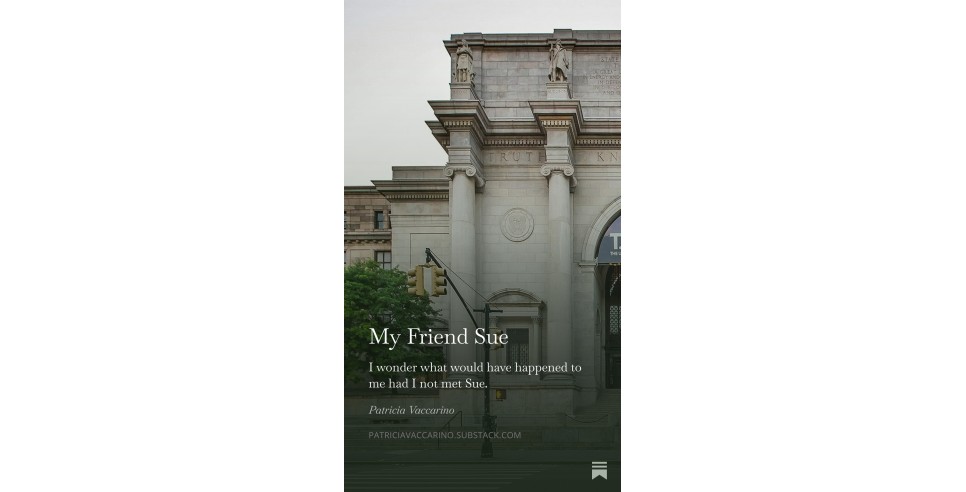
Sue Klofak was my closest childhood friend. We were Yonkers kids, working-class, playing street games: kickball, basketball, football. We swapped books. It became a competition to see who would finish first. Sue usually won. Between the two of us we read hundreds of books.
Our love of learning manifested itself in very different ways. Sue collected rocks, fossils and bugs. I wrote stories and poetry. Together we put on carnivals, posted flyers everywhere and charged all the other kids admission.
In high school our paths diverged. She won a scholarship to Barnard College. I became a rebel and was expelled from a Catholic high school. I cut a deliberate swath through Yonkers, a city that had grown too small for me, and headed west to see America.
I lost touch with Sue for many years. I moved to Seattle, built my own public relations firm, and wrote press materials, articles, essays and books. My business frequently brought me back to New York City. I learned Sue had stayed in New York to become a paleontologist at the American Museum of Natural History. I was astonished that the things we did as little kids predicted who we would become as adults.
I think we might have been acorns.
A theory about acorns asserts who we are destined to become is imprinted on our souls from the first moment of our lives. Jungian psychologist James Hillman wrote “The Soul’s Code,” emphasizing that each person is like an acorn that has the potential to become a great oak tree. No matter what obstacles the acorn encounters, one day it will grow to be an impressive oak tree, with the following caveat. No one knows how long the tree will live. It depends on the acorn’s distinct destiny.
I began to wonder what would have happened to me had I not met Sue.
Whenever I traveled to New York, I visited her at the Museum, making up for the time lost between us. We both marveled that we had escaped a blue collar fate. Other Yonkers girls took service jobs as health care workers or waitressing, a few taught in public schools. There wasn’t anything intrinsically wrong with these jobs, except they were so Yonkas.
Sue and I used to go to Big Nick’s Burger & Pizza Joint on 77th and Broadway. It was hard to pick a burger from Big Nick’s forty-page menu. Sue liked the Sumo Burger; over a pound of beef, it was as large as her head. Sue loved going to the Silk Road, a Chinese restaurant on the Upper West Side that served wine and beer for free. Cream puffs, the New York Mets, her small apartment in the Bronx, where she lived with her two cats, were among her favorite things.
In her work as a paleontologist, she had a penchant for Cephalopod Fossils, and co-authored several peer-review articles with her boss Neil H. Landman. She worked on the sixth floor of the Museum, outside of Neil Landman’s grand corner office, in a cramped, dusty room full of long wooden tables covered with fossil collections. Many of the fossils sat in open trays, awaiting her expert classification. She explained that Fossil Cephalopods were related to the Octopus, but they had hard shells that could be curved or straight.
Sue rarely ventured outside of New York. Once a year she went on an archeological dig somewhere on American soil in fossil country: Colorado, Arizona, Nevada. The way she spoke about these trips made her face soften to resemble the child who had once swapped books with me. She reconnected with her peers and adored the comradery. Everyone knew everyone else in this community that celebrated Cephalopods.
Even when she didn’t leave New York, her assignments took her beyond our working-class neighborhood in Yonkers. One year the Museum had an exhibition on Pearls, featuring more than eight hundred specimens. The exhibit touted the natural history and exquisite role pearls have played in human civilization. Sue met with a wealthy donor who was loaning her personal collection to the Museum. She traveled across town to the 5th Avenue home of a Persian Princess, who entrusted Sue with a cache of jumbo pearls. The princess confessed she had played with the pearls as a child because she thought they were marbles.
Sue knew pearls have been revered for their beauty since antiquity. It is only befitting that a Princess from Iran should own a treasure chest full of perfectly round, iridescent orbs. The Museum’s exhibit on pearls promoted cultural awareness as part of an effort to help New York City heal from the horrific events that had happened on September 11, 2001. Pearls notwithstanding, Sue was not inclined to wear a classic pearl necklace like the one bought by Joe DiMaggio for Marilyn Monroe, which was also part of the exhibit. She’d rather talk about the pearly nautilus, a living fossil that has wandered the South Pacific for 500 million years.
We all know people whose lives have been cut short.
Sue’s last trip outside of New York took her to an archeological dig in Nevada. On the first night of the conference, there was a reception. Sue felt a headache coming on. The pain mounted until she couldn’t bear it any longer, and she checked into her room for the night. She went to bed and never woke up. She died from a cerebral hemorrhage, aneurysm, a burst in the brain that bleeds.
There was no warning that this mighty oak tree would fall.
Sue had an indelible essence, the imprint of an acorn. She and I were destined to meet as children. Swapping books became the bedrock between us, foretelling who we would become. The mission of the acorn is to keep growing by putting down one root after another. Sue’s beloved Cephalopod means head, foot in Greek. The head guides the feet, or fast traveling feet bring the head along for the journey, until we become the extraordinary oak tree that will stand with time, even though no one know how long that time will be.
My Friend Sue is an essay in my collection NOTES FROM THE WORKING-CLASS.
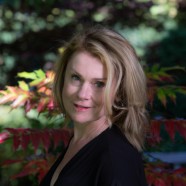
Patricia Vaccarino
Patricia Vaccarino is an accomplished writer who has written award-winning film scripts, press materials, articles, essays, speeches, web content, marketing collateral, and eleven books.