






August is hot in Reno, with daytime highs regularly in the 90s and, increasingly, blistering spikes up over 100 degrees. Visitors who come through town in the summer hoping to see some “green” are probably hoping they’ll do so by hitting the jackpot at one of the big casinos in town.
However, there are a couple of leafy green alternatives within city limits. Close to the University of Nevada, Reno campus, for example, Rancho San Rafael Regional Park includes the Wilbur D. May Arboretum and Botanical Garden, which offers plenty of tree canopy – and squirrel antics – over 23 hilly acres.
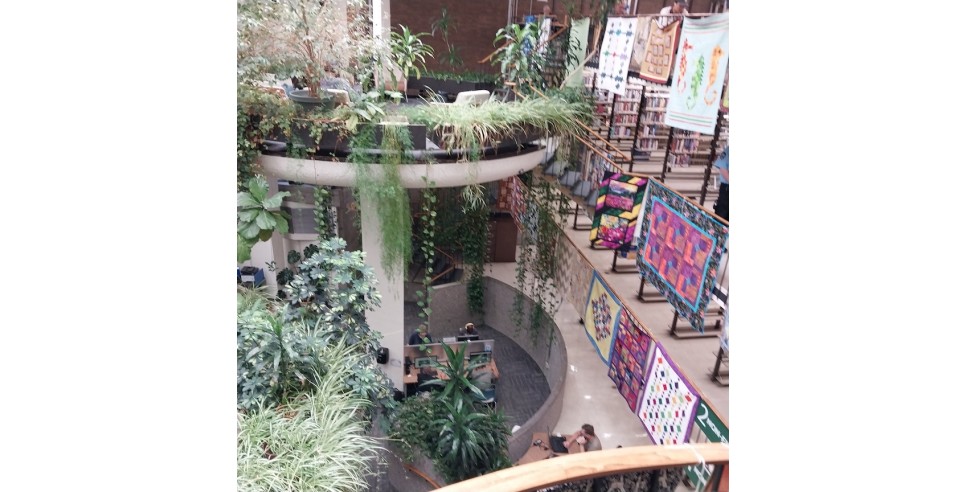
But even there it can be hard to beat the summer heat, so that’s when people in the know head back down the hill to the Downtown Reno Library on Center Street. This isn’t your typical air-conditioned library. Push through the doors and you’ll find yourself walking onto a vine-bedecked bridge through a jungle atrium. There are thousands of plants here – begonias and philodendrons, mother-in-law tongues and spider plants, aloe vera, an avocado tree, Norfolk pines, and so much more.
“We’ve got about every indoor plant you can get,” says Leon Lewis, co-owner with his wife Lynda of Green Interiors, and caretaker for over two decades of the plants that flourish in this unique library bower.
The building was designed back in the 1960s, opened in 1966, and honored with the Industrial Landscape Award in 1968, presented by Lady Bird Johnson.
But perhaps it wouldn’t have been quite so intriguing a structure had things gone according to plan. It’s fitting that there’s an interesting story with a twist behind the Library’s design. Architect Hewett C. Wells received the assignment to design the building in what was then the Contemporary style, emphasizing simplicity and compatibility with the landscape.
Initially, the building was to be sited within a park alongside the Truckee River, which tumbles through the heart of Reno’s downtown. But various objections were raised about the suitability of that site. So, in response to public concerns, a new location was selected a few blocks away, and Wells made a 180-degree pivot: he decided to put the park inside of the building.
The result has been, for 60 years, a stunningly beautiful home for books, built around a four-story-tall garden atrium. The ground floor, which is below street level, is called the garden level, because that is where the trees that were planted as young saplings 60 years ago remain rooted, although today they stretch up four stories to the skylights in the ceiling above. Hewitt also designed columns that rise up from the ground floor to hold reading pavilions, something like tree house platforms, that seem to float among the living branches.
The floors that surround the atrium contain the library’s book collections and makerspace. The library also includes an auditorium, archives, art gallery, a fountain – and a bomb shelter. It was the 1960s, after all, and the arms race was on.
But back to what makes this space so truly unique: the plants and the fellow who has been looking after them for so long. Leon Lewis was born in Los Angeles. As a young man, he served a stint in the Air Force, then moved around a fair bit before settling in Reno with the aim of becoming a hairdresser. But life doesn’t always go according to plan.
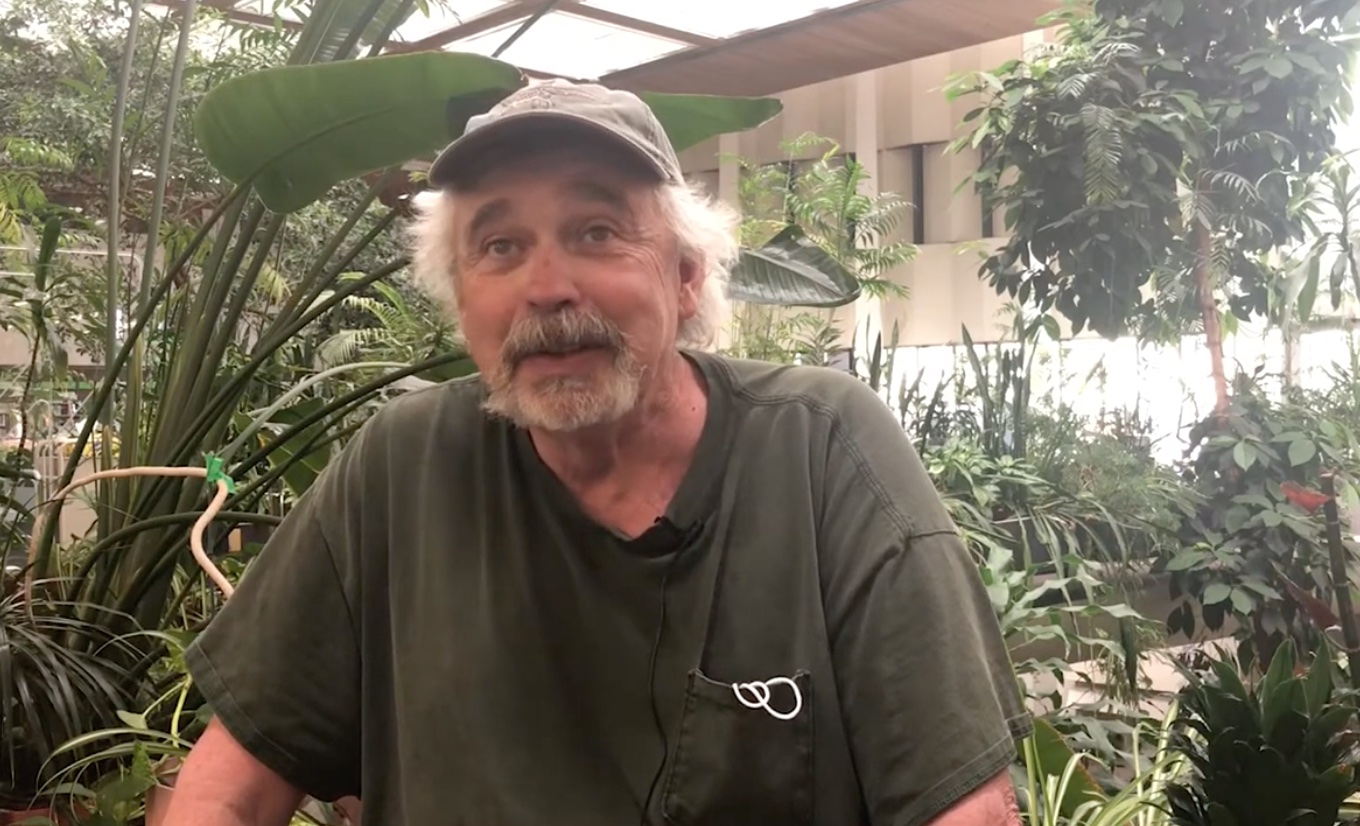 Because Lewis had enjoyed growing things since middle school (“I took some agricultural classes, we grew radishes and stuff like that”), he seemed to gravitate toward plants, and his wife was a gardener, too. Lewis started up a side hustle as a “mow man,” but in Reno, nestled up against the Sierra Nevada range, that’s a strictly seasonal gig – five months out of the year, tops.
So, Lewis says, he and his wife looked at each other and said, “What the heck, let’s do an indoor plant business.”
This was in the early 1990s, and they acquired a number of business clients, including another Reno office building that had an interior atrium, before approaching the library and offering their services.
It took a few years, Lewis conceded in a recent YouTube video produced by the Library. “But we just kept bugging them, and they finally gave us a shot.”
By this point, he’s been looking after the Library’s atrium plants for nearly a quarter of a century.
The gardener comes in weekly, using a 230-foot hose for watering and a long pole for whacking off dead leaves. Without any other assistance, he marches up and down all of those steps, to all of those different floors as well as all of those reading pavilions, to ensure that each individual plant is hand-watered, nourished and free of disease or infestation.
“It keeps me young,” he jokes.
And it certainly keeps those plants healthy, too. So, judging by the look of things, is he a plant whisperer?
“Naw,” Lewis demurs. “I don’t talk to them unless I’m mad at them. Sometimes I have to tell ‘em: ‘You straighten out or you’re going to the dump!’”
There are other times when some of the smaller plants in pots get “checked out” of the library by light-fingered library patrons, never to return. “The librarians might not notice, but I do, because I’m intimately involved with the watering,” Lewis says.
On a more uplifting note, the Library also receives donations from people whose houseplants have outgrown their homes. For example, the avocado tree that was mentioned back at the start of this piece: back in the 1960s, it started out in somebody’s kitchen as an avocado pit, spiked with toothpicks and set over a glass of water to root. Lewis says that the plant is so enthusiastic now he has to bring in a service every 18 months or so to cut the tree way back down to size – otherwise it would be pushing up against the Library skylights, four stories up.
The Library continues to get accolades and recognition. In 2013, it was honored – three years early – by jumping past the 50-year waiting period since opening and being named to the National Register of Historic Places.
Since then, it has been named “coolest interior space” in a national contest. During a searing hot August like this one, that distinction might be interpreted in a couple of different ways.
Barbara Lloyd McMichael is a freelance writer living in the Pacific Northwest. Check out her Pacific Rim Story Laboratory website

Barbara McMichael
Barbara Lloyd McMichael is based in the Pacific Northwest and writes about books and culture. She writes a syndicated weekly book review column called “The Bookmonger” that focuses on Northwest books and authors. Her PR for People® Book Review is written exclusively for The Connector.