




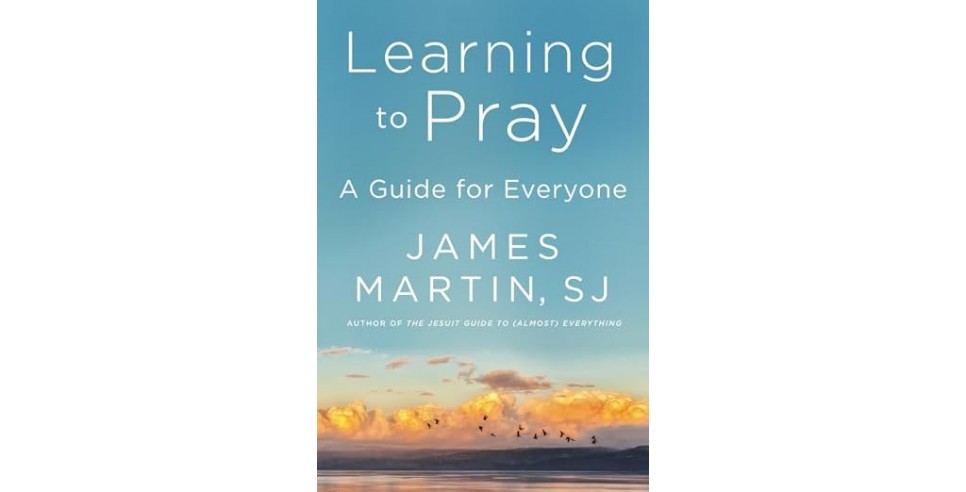
Learning to Pray
A Guide for Everyone
By James Martin, SJ
Harper One An Imprint of Harper Collins
pp 386
In my own unsophisticated way, I pray every day. I’m open to learning more about prayer, but Father James Martin’s book Learning to Pray did not take me to the higher level of prayer that I have sought.
The first three chapters are disappointing. Father James spends considerable time establishing his expertise, or rather his experience, bolstering his ability to guide us in prayer. Too much time is also spent on all the reasons why we don’t pray, or why prayer is tedious and dogmatic. Going into stodgy detail about the downside of prayer is a turnoff. The person who reads this book is intent on learning about prayer on a deeper level. The author needed to keep in mind that he is preaching to a choir that has already begun to sing.
The book is full of endless lists. One section describes the awful Seven Ds—that is what one experiences when one is praying mightily but getting no response. Here are the Seven Ds: Darkness, Dryness, Desolation, Doubt, Disbelief, Depression, Despair. This is only one list of many.
The book is also full of endless quotes from saints, Jesuit priests, authors, and mystics. “Prayer is a long, loving look at the real,” says Walter Burghardt, but I don’t know what this quote means.
Father James does note that “One hallmark of Jesuit spirituality is finding God in all things.” Finding God in all things is central to having an ongoing conversation with God. Father James suggests we can see God in the natural world, among fields, mountains and forests, which is good, but he does not mention that God is also found in the outward expression of Art, Music, Literature, Film, in all of the human creative endeavors that show the entire glory of God’s creation.
In his discussion about hearing voices, Father James cautions the reader toward “ruling out any psychological illness,” which is hugely disappointing. Half of the saints who espoused the Catholic faith heard voices. What do we make of Paul on the Road to Damascus, when he heard a voice saying, “Saul, Saul, why are you persecuting me?,” and then he was blinded for three days?
There are redeeming passages in the book regarding formal prayer regimens, such as The Examen, a step-by-step walk through prayer, and the Lectio Divina, a divine reading that is contemplative in nature. Mentioning how God might speak to us is also of great value. “God speaks to us in ways tailored to the fabric of our individual lives.” It was also valuable to discuss how important it is to share all of our emotions with God, including the negative ones, things that make us angry, sad or full of despair.
On sharing emotions with God, the author also states: “That doesn’t mean all emotions must be expressed at all times and in all places—only babies do that.” Well, I haven’t found any babies who pray, nor do I know of any babies who exhibit emotions “at all times in all places,” but I do know if babies die without being baptized they will most certainly land in the “Catholic” netherworld of limbo.
Overall, this book is a rote rendering of very important aspects of living a prayerful life. There is far too much filler content, which can often be due to the terms of the author’s book contract. A longer book nets a larger advance, more dollars, and a bigger “book deal.” I’m grateful for the book, though, because it made me think about how to rescue my prayer life from mediocrity.
There are lessons that could have guided the reader to create his or her own prayer. Greater depth could have been given to understand that every original prayer is as unique as its owner, an ongoing conversation with God.
Where is the feeling, the intuition and the temporal, ephemeral tenderness that results from communion with God? Where is the passion?
It would have been wise to set forth “triggers” to guide readers to create their own individual prayers, love poems to God. St Augustine wrote Interior intimo meo et superior summo meo “God is closer to me than I am to myself.” Let us ask God to show us who we are in God’s eyes.
Instead, the book is limited by its tight, unyielding construction of prayer. Father James includes a quote by the Jesuit astrophysicist Guy Condolmagno: “God is bigger than religion.” God is also bigger than Catholicism, and indeed bigger than Father James Martin. We ought to probe the true meaning of Catholicity, which is greater than universality and really means wholeness. Wholeness is where deep prayer resides.
Patricia Vaccarino
Patricia Vaccarino is an accomplished writer who has written award-winning film scripts, press materials, articles, essays, speeches, web content, marketing collateral, and eleven books.