









Sometimes, in the din of mindless chants of “drill, baby, drill,” it’s easy to think that no one cares about the environment anymore. The Trump administration, almost daily, cuts rules, regulations, budgets, agencies (or changes their purpose) established decades ago to protect our land, water, air and resources. And yet my recent travels and exchanges, related to my new film Econoclast: Herman Daly and the Gospel of Growth (www.econoclast.film) give me hope that all is far from lost.
ARTIFICIAL INTELLIGENCE
Indeed, I have found in my recent travels that our impact on the environment features prominently in each of the three issues that now most resonate with both progressives and conservatives. The first is the sudden upsurge of opposition to unregulated artificial intelligence and the alarming spread of data centers. Despite Trump’s shallow calls for the continued expansion of “superintelligence” as he calls it, fears of the potential power of AI is not confined to environmental activists. Several AI developers, including a former lead developer for Anthropic, have warned that rogue AI could actually destroy our civilization and even humanity itself. Recently, Bill Gates warned interviewer Ezra Klein of the dangers.
A.I. has crossed the threshold that its ability to empower a bioterrorist to kill hundreds of millions exists today. The ability to do a cyberattack that scrambles all of the bank accounts, shuts down the electric grid — that exists today, and we know that’s the case. This is the most dangerous thing that humans have ever gone near.
Moreover, the proliferation of data centers is the leading source of all new electricity use in the US today and a threat to water supplies in many communities. It is also leading to energy and water cost increases for many Americans, which is one reason the New York Times found that more than 70 percent of Americans now oppose the construction of new data centers. Moreover, AI threatens millions of jobs and the livelihoods they support.
This is a fight between the great majority of us who want a safe society, a clean environment, affordable water and energy and gainful employment, versus the richest few among us who stand to profit from the unregulated spread of AI.
PUBLIC LANDS
Under Trump, a wholesale attack on our public lands is underway, and Americans across the political spectrum fear the outcome. In Utah, for example, the administration has nearly eliminated Bears Ears and Escalante National Monuments, land sacred to Native Americans and loved by those who appreciate the wilderness. DOGE and Trump more generally have slashed National Park budgets at a time when more Americans than ever from across the political spectrum are visiting them. A few weeks ago, I was invited to show one of my films in Springdale, Utah, just outside Zion National Park. The Park itself was filled with tourists from across the US and around the world. Just when a burgeoning population needs more places to find refuge and solace from an overcrowded world, Trump has dumped the Forest Service’s Roadless Rule, potentially allowing massive destruction of public lands. Even in the intermountain West, citizens want more protection of public lands, not less.
Twenty five years ago, Republican pollster Frank Luntz warned George Bush not to cut funds or protection for parks and public lands because his GOP supporters cared just as much for them as Democrats did. When I produced a film about the life of former Interior Secretary Stewart Udall (www.stewartudallfilm.org), I discovered that many of the strongest supporters of his 1960s environmental protections were Republicans, led by Pennsylvania Congressman John Saylor.
During Trump’s first term, the legislation that passed with the most bi-partisan support in Congress was the Great American Outdoors Act, providing more resources for parks, public lands and natural recreation. Trump signed it, but it would have easily passed over a veto if he hadn’t. The Act included more support for the Land and Water Conservation Fund, which uses money from taxes on fossil fuel production to fund parks, trails, and protection of wildlife, water and land in hundreds of American towns and cities. Though most Americans have never heard of the fund, it may be the most important single piece of environmental legislation ever passed in the US. Today, the Trump administration has been trying to reduce it, but support for the Fund comes from both Left and Right.
Just as Katharine Lee Bates did when she wrote the splendid anthem AMERICA THE BEAUTIFUL (see www.seatoshiningseafilm.org), most Americans treasure the beauty of our land, water and wildlife. A new campaign like the Civilian Conservation Corps of the 1930s could unite millions of us across party lines to restore our environment and allow nature to heal itself and us. A recent movement called ParksRx, started by physicians, promotes time in nature as an important way to improve our health, now unquestionably the worst in any rich country.
CONSUMERISM
Last year in the Washington Post, Utah’s Republican Governor Spencer Cox warned that our focus on consumerism and materialism was destroying American society from within. And surprisingly, Vice President Vance’s new book COMMUNION addresses the issue in its penultimate chapter, suggesting that our focus on economic growth and the Gross National Product is a fool’s errand that does not improve wellbeing but instead increases dissatisfaction and addiction among other negative outcomes. Both recent Catholic popes have warned that a consumerist attitude, which treats nature as a commodity instead of a sacred trust, is leading to climate and biodiversity destruction and must be challenged.
While Americans are far richer in material terms than they were 50 years ago, they work longer hours with more stress and are less happy than they were then. Between 2012 and 2025, the US fell from 11th in the World Happiness Report of the United Nations to 24th, despite a rapidly rising GDP.
We Americans are awash in a sea of commercial messages bombarding us every day to buy more and more. Our “engineers” now build algorithms to probe our every habit and desire in hopes of selling us more and more instead of designing bridges. We are constantly at the mercy of an endless supply of appeals to materialist values at the expense of social connection and spiritual growth. Psychologists call such values—fortune, fame, stuff, glamor, power, wealth, etc.—“extrinsic.” But they find that people whose values are more “intrinsic”—love, friendship, creation, idealism, beauty, altruism, etc.—tend to be happier. Yet our capitalistic society constantly promotes the extrinsic.
This orientation to stuff, what I called “affluenza” in my 2001 international best-seller, is not only bad for our psychological health and overall happiness; it is destroying the world we live in. The signs are everywhere: growing stress, addiction, depression anxiety, even suicide; plastics filling our oceans; microplastics polluting our bodies; ever-increasing catastrophic climate events; cities growing too hot or dry for human habitation; loss of 75% of the world’s wildlife in 50 years; massive destruction of habitats; an ecological footprint far in “overshoot”—were the world to copy the American standard of living we would need five planets to sustain the use of resource and assimilate the waste.
Wars over resources like our current blood-soaked imperialist designs on Venezuela and Iran destroy vast areas of land as well as human lives. We can’t grow on like this. Overconsumption needs to become part of our political conversation. The price of gasoline would actually be far higher if we had to include its “externalities”—the cost of undoing the damage being caused by fossil fuels. But the climate, our health and our social connection would be much improved.
A MORAL REVOLUTION
While those on the Right, and even many on the Left, won’t agree with all of these points, there are clearly elements within them that can unite us and allow us to go beyond the hateful polarization of the Trump years. We can begin to seek a way forward that is better for us and for the planet. To do so, we may need a moral revolution, an understanding that it’s also not just about people; millions of other species also have a right to live. This may be the great moral issue of our time, akin to the fight to abolish the evils of slavery and fascism. Can we rise to the task, one nation out of many, native born and immigrant alike, male and female, of all colors and creeds, young and old, dreaming of social justice and a livable world? I think we can. Do you?
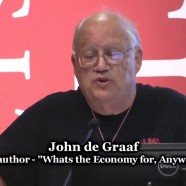
John de Graaf
John de Graaf is an author, award-winning documentary filmmaker and president of Take Back Your Time, an organization fighting overwork and time poverty in America.